
- Business Automation
- Business Operations
- CRM & Sales Operations
- Enterprise Software
- Enterprise Technology
- Insights
- MyTalent
- Software
- Web & Mobile Development
- Workflow Automation
Logistics Workforce Management Software
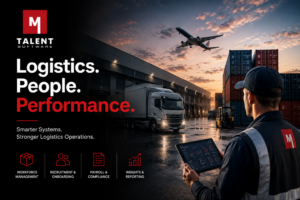
The logistics industry never stops moving.
Behind every successful delivery, warehouse, distribution centre, and transport operation is a workforce responsible for keeping goods, information, and services moving efficiently.
But managing that workforce can be complex.
Logistics businesses often operate across multiple locations, shifts, warehouses, depots, and operational teams. Recruitment, onboarding, payroll, compliance, employee documentation, leave, performance, and communication all need to work together — often at significant scale.
When these processes are managed through disconnected systems, spreadsheets, paperwork, and emails, administration increases and visibility decreases.
Modern logistics businesses need connected workforce technology that can keep pace with their operations.
When your business is always moving, your people and processes need to move with it.
Managing a Complex and Distributed Workforce
Logistics organisations rarely operate from a single location or follow a traditional nine-to-five working day.
Employees may be spread across warehouses, distribution centres, offices, transport hubs, and operational sites, often working different shifts and schedules.
This makes maintaining accurate employee information and managing everyday HR processes increasingly challenging.
Centralising workforce information gives HR teams and managers greater visibility across the organisation while creating a more consistent experience for employees.
Simplifying Recruitment and Onboarding
Finding and onboarding the right people quickly is critical in logistics.
Seasonal demand, business growth, staff turnover, and changing operational requirements can create continuous recruitment needs across drivers, warehouse teams, administrators, supervisors, and management.
Connected recruitment processes help businesses manage candidates more effectively and move successful applicants into onboarding without unnecessary duplication.
Digital onboarding can also ensure new employees receive the correct documentation, policies, and information before entering the workplace.
Making Payroll and Employee Administration More Efficient
With different roles, locations, shifts, and employment structures, payroll administration can become one of the most demanding areas of workforce management.
Disconnected HR and payroll information creates unnecessary manual work and increases the risk of errors.
Bringing employee information and payroll processes closer together can reduce duplication, improve data accuracy, and give HR and payroll teams better visibility across the workforce.
Employee self-service can further reduce administration by allowing employees to access payslips, request leave, update information, and find important documents digitally.
Supporting Compliance Across the Organisation
Compliance is particularly important in operational environments.
Employee records, contracts, policies, training information, certifications, approvals, and other workforce documentation need to remain accurate and accessible.
When this information is distributed across spreadsheets, inboxes, and filing systems, maintaining oversight becomes increasingly difficult.
Centralised records and structured digital workflows help organisations improve accountability and maintain greater control over important workforce information.
Connecting Employees Across Locations
Communication becomes more challenging as organisations become larger and more distributed.
Employees working in warehouses, depots, distribution centres, and on the road may not have the same access to traditional internal communication channels as office-based employees.
A connected employee experience helps businesses make important information, documents, and workplace processes more accessible regardless of where employees are working.
This can create a stronger connection between operational teams and the wider organisation.
Turning Workforce Information Into Better Decisions
Managing people effectively isn’t only about reducing administration.
Connected workforce data can give management a clearer picture of what is happening across the organisation.
Better visibility into employee information, recruitment, leave, payroll, performance, and other workforce processes can help leaders identify trends and make more informed decisions.
As logistics businesses grow, this visibility becomes increasingly valuable.
Building a More Connected Logistics Business
The future of logistics operations isn’t simply about moving goods faster.
It’s about creating an organisation where people, information, and processes can move efficiently too.
By replacing disconnected systems and manual administration with integrated workforce technology, logistics organisations can create simpler processes, improve visibility, and give their teams more time to focus on operational performance.
Empowering Logistics Organisations with MyTalent
At MyTalent Software, we bring HR, payroll, recruitment, compliance, employee engagement, and business processes together in one integrated platform.
From transport and warehousing businesses to distribution operations and larger logistics organisations, MyTalent helps businesses simplify workforce administration and connect employees across locations.
By bringing people, processes, and information together, logistics businesses can spend less time managing administration and more time keeping their operations moving.
Because when your people work better together, your business moves better too.
Related Post

The Future of Business Operations Is Connected Systems
Modern businesses rely on more technology than ever before. Most organizations now…

Why Operational Efficiency Is Becoming a Competitive Advantage
For many years, businesses competed primarily through: pricing products market reach branding…
The Hidden Cost of Manual Processes in Growing Businesses
Many businesses don’t notice operational inefficiencies during the early stages of growth.…

The New Era of Insurance: Faster, Smarter, More Customer-Centric
Transforming Insurance Operations with Smarter Technology Insurance providers face growing pressure to…
Property Operations Management Software
The property industry is built on relationships, responsiveness, and results. But behind…